Resealing Failed Flashing vs Full Flashing Replacement: How the Right Call Gets Made on Connecticut Properties
Flashing is the most common source of roof leaks on Connecticut Shoreline homes, and it is also the most commonly misdiagnosed. When water shows up at a chimney, skylight, dormer, or wall intersection, the assumption is usually that the shingles failed. More often, the flashing did, and the repair path depends on exactly how it failed.
That matters because flashing failures come in two very different forms. A sealant joint that has dried out and cracked is one problem. Flashing metal that has corroded, lifted, or been installed incorrectly is a different one. Resealing the first restores protection at a fraction of the cost and disruption of replacement. Resealing the second is a temporary patch on a problem that will come back, often within a season.
Right now, in the late-summer calm before fall nor'easter season, is the practical window for addressing a flashing issue. Nor'easters deliver the sustained, horizontal rain that finds every flashing weakness a summer thunderstorm might not, and a flashing failure caught in August is a targeted repair rather than an emergency in November.
Roof Repair Pro is a repair-only roofing specialist serving the Connecticut Shoreline from North Branford. Flashing repair is one of the most common services the team performs, and this is how the reseal-versus-replace decision actually gets made on the roof.
What Flashing Actually Does and Why It Fails
Understanding the reseal-versus-replace decision starts with understanding what flashing is protecting and where it is vulnerable.
Flashing is sheet metal, typically aluminum, galvanized steel, copper, or lead, installed at every transition point on a roof where the shingle field meets something else: a chimney, a skylight, a dormer wall, a vent pipe, a valley, or a wall intersection. Its job is to bridge the gap between the shingle plane and the penetration and channel water over the transition rather than letting it in underneath.
Two things hold flashing in place and keep it watertight:
- The mechanical installation secures the metal to both surfaces, typically with a combination of step pieces, counter-flashing, and fasteners
- The sealant fills the joints where the metal meets masonry, siding, or adjacent flashing pieces, creating a flexible waterproof bond at the edges
Flashing fails when one or both of those elements gives way. The sealant can dry, crack, and pull away from the surface it is bonded to. The metal can corrode, fatigue from thermal cycling, buckle, or lift under wind loading. Which one failed determines whether resealing or replacement is the right response.
When Resealing Is the Right Answer
A reseal is appropriate when the flashing metal itself is sound and properly positioned, and only the sealant has failed. This is the simpler, less expensive, and less disruptive repair, and on many CT Shoreline homes it is all the flashing needs.
Sealant failure is the most common flashing issue Roof Repair Pro encounters. The caulk, roofing cement, or polyurethane sealant used at flashing joints has a finite life, typically 5 to 15 years depending on the product and the exposure. On a Connecticut Shoreline property, where salt air degrades organic sealant compounds and UV breaks down elasticity, that life is at the shorter end of the range.
Signs that a reseal is the right call:
- Visible gaps, cracks, or pulling in the sealant at flashing edges
- Water intrusion that traces to a joint rather than a metal failure
- The flashing metal is still flat, tight, and free of corrosion
- The original installation is mechanically sound and properly lapped
What a proper reseal involves:
- Complete removal of the old, failed sealant
- Cleaning and preparation of both surfaces
- Application of a high-quality, UV-stable, flexible sealant rated for the specific materials
- Inspection of the surrounding flashing to confirm no metal failure is present
A reseal done correctly on sound metal restores the waterproof seal for another 7 to 15 years depending on the product and exposure. A reseal done over old sealant, or on metal that is actually corroded underneath the caulk, fails quickly because the underlying problem was never addressed.
When Full Replacement Is the Right Answer
Replacement is warranted when the flashing metal itself has failed, because no sealant can compensate for metal that is corroded, lifted, buckled, or improperly installed. This is the more involved repair, but it is the only one that solves a metal failure.
The metal failures that require replacement:
- Corrosion that has thinned or perforated the metal. Galvanized steel flashing on older CT Shoreline homes corrodes over decades, and once the zinc coating fails, the steel beneath deteriorates. Corroded flashing that has lost structural integrity cannot be resealed into reliability.
- Flashing that has lifted or buckled under wind or thermal cycling. Metal that is no longer lying flat against both surfaces has lost its mechanical connection. Resealing the edges of buckled flashing does not restore the seal because the metal is no longer in the position it needs to be.
- Improper original installation. Flashing that was installed with incorrect lapping, insufficient overlap, missing counter-flashing, or improper integration with the shingle field is a design failure, not a sealant failure. Resealing an improperly installed piece locks in the installation error.
- Dissimilar metal corrosion. When different metals are in contact, galvanic corrosion accelerates the failure of the less noble metal. Aluminum flashing fastened with steel nails, or copper in contact with galvanized steel, produces corrosion that resealing cannot stop.
What proper replacement involves:
- Removal of the failed flashing and any surrounding damaged material
- Assessment of the deck and underlayment beneath for moisture damage
- Installation of new flashing to the correct specification, properly stepped, lapped, and counter-flashed
- Integration with the existing shingle field
- Appropriate sealant at joints on the new installation
The Decision Framework
The reseal-versus-replace call comes down to one central question: is the metal sound?
| What the inspection finds | The right response |
|---|---|
| Sealant cracked or pulled, metal sound and flat | Reseal |
| Sealant failed at chimney crown or step joint, metal intact | Reseal |
| Metal corroded, thinned, or perforated | Replace |
| Metal lifted, buckled, or no longer flat | Replace |
| Counter-flashing missing or improperly installed | Replace |
| Dissimilar metal corrosion present | Replace with compatible materials |
| Metal sound but sealant has been repeatedly patched | Assess metal carefully, likely replace |
The last row deserves attention. Flashing that has been resealed multiple times, with layers of old caulk built up at the joints, is telling the inspector something: either the sealant keeps failing because the metal underneath is compromised, or the previous reseals were done without removing the old material, which means none of them bonded properly. Either way, a history of repeated patching at the same location usually points toward replacement.
Where Flashing Fails Most Often on CT Shoreline Homes
Every roof has flashing, but certain locations concentrate the failure risk, and knowing where to look helps homeowners catch problems before the fall storm season tests them.
Chimney flashing.
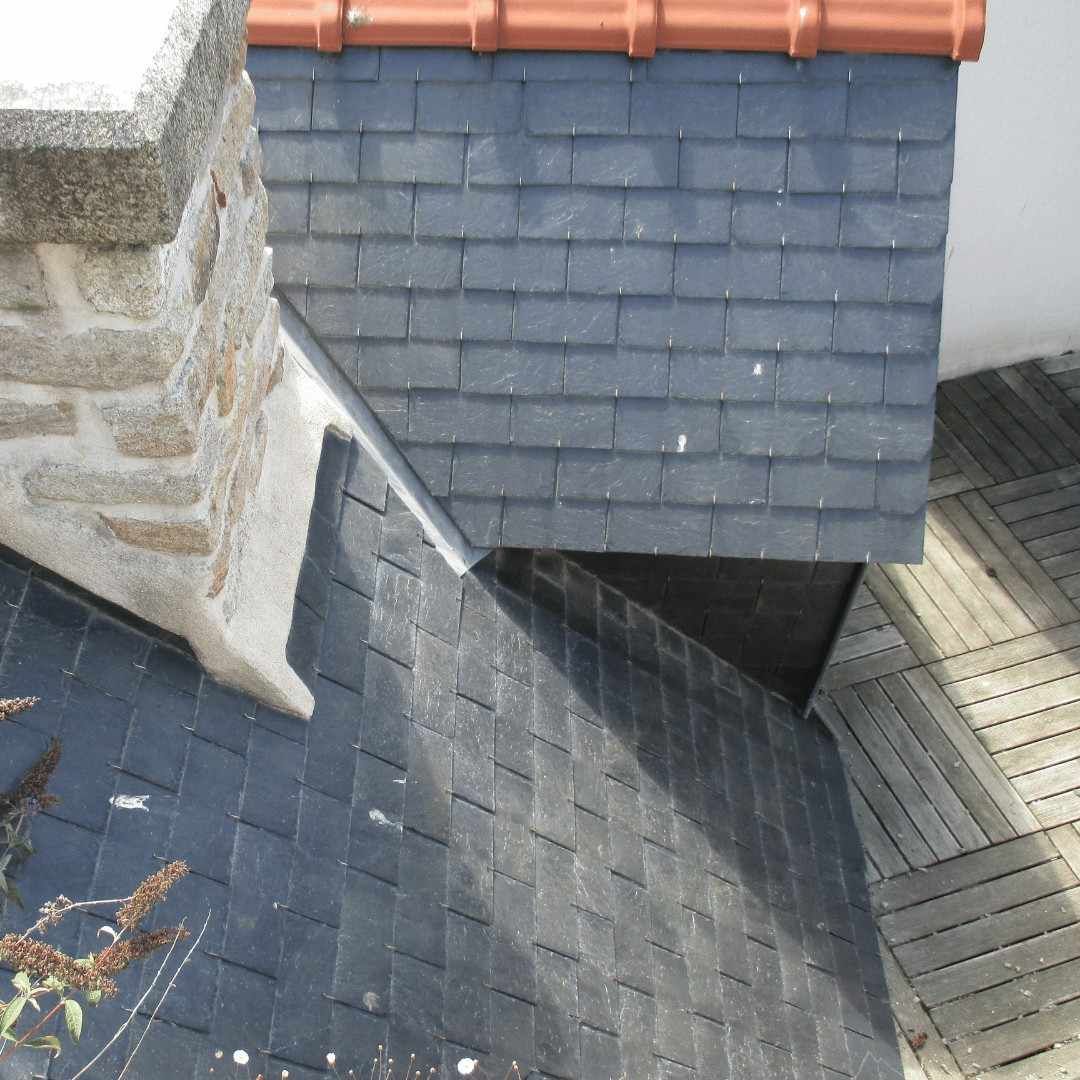
The chimney-to-roof intersection is the single most common flashing failure point on Connecticut Shoreline homes. The junction involves multiple flashing pieces, step flashing on the sides, a head flashing or cricket at the upslope side, and counter-flashing embedded in the mortar joints, all of which have sealant joints that age and metal that corrodes. Chimney masonry also moves independently from the roof framing, which stresses the flashing connection.
Skylight flashing.
Skylights sit in the middle of the shingle field with water flowing around them from all sides. The flashing that surrounds a skylight has to manage water from above, deflect it around the sides, and seal at the bottom edge without creating a dam. Sealant failure at any of these points produces a leak that appears inside the home at or near the skylight.
Dormer wall step flashing.
Where a dormer wall meets the roof plane, step flashing is woven into the shingle courses to channel water down the wall and off the roof. When the sealant at the top of the step flashing fails, or when the step pieces themselves corrode, water enters the wall cavity behind the siding rather than staying on the roof surface.
Vent pipe boots.
The rubber or neoprene boot that seals around plumbing vent pipes degrades in UV and temperature cycling, cracking and pulling away from the pipe. This is one of the simplest and least expensive flashing repairs, and also one of the most neglected because it is not visible from the ground.
The Cost Difference and Why It Matters for the Decision
One of the most useful pieces of context for a homeowner weighing reseal versus replace is the cost relationship between the two, because it clarifies the stakes.
| Repair type | Relative cost | What you get |
|---|---|---|
| Proper reseal | Lower, typically a fraction of replacement | Restored seal on sound metal, 7 to 15 year life |
| Full flashing replacement | Higher, more labor and material | New metal, new seal, new installation, 20 to 30 year life |
| Resealing metal that should have been replaced | Lowest upfront, highest over time | Temporary fix that fails again, often within 1 to 2 seasons |
The third row is the trap. A reseal costs less than a replacement in every case, which creates a temptation to reseal everything regardless of whether the metal warrants it. When the metal is actually compromised, that lower-cost reseal buys a season or two before the same leak returns, and the homeowner pays again. Over the life of the problem, repeated reseals on bad metal cost more than a single replacement would have.
This is where the repair-only positioning matters. Roof Repair Pro does not install new roofs, so there is no incentive to push a homeowner toward a larger job. But there is also no incentive to undersell a problem. If the metal needs replacing, the inspection says so, because a reseal on corroded metal is a disservice to the homeowner regardless of which option costs less today.
Why This Matters Before Nor'easter Season
The Connecticut DEEP Coastal Hazards primer describes the nor'easter as a defining coastal weather event producing sustained high winds and heavy precipitation. The NOAA Connecticut State Climate Summary documents extreme precipitation events becoming more frequent.
Nor'easters test flashing differently than summer storms because of the sustained wind component. A thunderstorm delivers heavy rain for thirty to sixty minutes. A nor'easter can drive rain at the same intensity for twelve to thirty-six hours, and the wind direction keeps that moisture pushing into the same flashing joints for the duration. A sealant joint that holds through a brief storm can fail under sustained pressure, and a corroded flashing piece that has been limping along gives way when the exposure lasts that long.
Addressing a known flashing issue in August means the repair happens in dry conditions, the sealant cures properly, and the flashing enters the fall season in sound condition. Deferring it to the fall means the repair happens reactively, possibly in the wet, and the flashing absorbs another season of the sustained loading that is designed to find its weaknesses.
Roof Repair Pro's flashing repair service covers chimney flashing, step flashing, skylight flashing, vent boots, and valley flashing across Madison, Guilford, Branford, Old Saybrook, and Clinton. For broader storm damage that involves flashing alongside shingle damage, the storm damage service and the inspection and second opinion service cover the full assessment. The related article on storm damage repair versus full roof replacement explains how the larger repair-or-replace decision gets made when flashing failure is part of a broader damage pattern.
If your flashing is showing signs of sealant failure, corrosion, or a leak at a chimney, skylight, dormer, or vent on your Madison, Guilford, Branford, Old Saybrook, or Clinton property, Roof Repair Pro can inspect it, determine whether a reseal or a replacement is the right call, and complete the repair before the fall storm season puts it to the test.
Flashing Repair | Storm Damage Repair | Roof Leak Repair | Inspection and Second Opinion | Shingle Repair | Contact Roof Repair Pro
(475) 800-8876 | roofproofct.com | CT Shoreline | Licensed HIC #0690521