Why Temporary Roof Patches Should Be Properly Repaired Before Snow Arrives
A temporary roof patch can be exactly what a home needs during a storm. A tarp or emergency sealant may reduce water entry until permanent work is possible. Problems begin when temporary protection is mistaken for a rebuilt roofing detail. Before snow, homeowners seeking roof repair in Guilford, CT should know what remains damaged and what work must follow.
Winter adds weight, moisture, movement, and periods when a repair is difficult to inspect. Snowmelt can reach an old patch edge, refreeze, and reopen the same route. Madison, Branford, North Branford, and Clinton face similar weather, but repair depends on the roof system and original failure. A lasting solution removes unstable material and restores the water-shedding layers.
What a Temporary Roof Patch Is Supposed to Do
Temporary protection is meant to reduce immediate water entry when a permanent repair cannot be completed safely or correctly. During active rain, high wind, storm cleanup, or material delays, a tarp or emergency sealant can protect the building while the damaged area is assessed. It does not prove that the leak source has been fully diagnosed, and it may cover more than the actual opening. The follow-up plan should identify when the patch will be revisited and what component will be repaired.
Roof Repair Pro’s emergency roof repair service describes tarping as a temporary protective measure rather than a long-term repair. That distinction matters because a tarp relies on secure attachment and coverage, while roof cement depends on substrate preparation, compatibility, thickness, reinforcement, and weather. Neither approach automatically restores a lifted shingle course, corroded flashing system, cracked pipe boot, open membrane seam, or softened deck. Temporary work controls exposure; permanent work restores the roof system.
Common Roof Patches and Their Limitations
“Patch” can refer to several methods. Some are emergency measures, while others belong in approved repair assemblies. The key question is whether the product matches the roof and rebuilds the failed detail.
Common temporary approaches include:
- Roof tarps: Broad protection while permanent work waits.
- Roof cement: Short-term sealing that may leave loose roofing or weak backing.
- Flashing sealant: Protection at a gap, but not replacement for damaged metal.
- Cement over a boot: Surface cover that leaves split rubber in place.
- Adhesive patches: Product-specific protection requiring prepared, compatible surfaces.
- Loose covers: Unsafe material that can shift, trap water, or become debris.
| Temporary method | What it may accomplish | What it does not confirm |
|---|---|---|
| Secured roof tarp | Covers an exposed section | Exact source, substrate condition, final repair |
| Emergency roof cement | Slows entry at a crack or edge | Flashing integrity or material compatibility |
| Sealant bead | Closes a narrow joint temporarily | Condition beneath shingles or metal |
| Adhesive patch | Protects a prepared local area | Whether surrounding membrane remains bonded |
| Interior water collection | Protects belongings from a drip | Any control of exterior water entry |
Why Cold Weather Works Against an Aging Patch
Roof patches are exposed to the same expansion, contraction, moisture, ultraviolet light, and wind as the surrounding roof, but they may not move at the same rate. An old cement patch can become brittle, an edge can lift, or water can work between the patch and the original material. Snow then hides the surface while meltwater remains in contact with it for longer periods. If water enters the patch edge and freezes, it can place more pressure on an already weak bond.
Cold also affects installation. GAF’s technical data for MATRIX 204 Wet/Dry Roof Cement states that the product should be applied when temperatures are 45°F and rising, and that cold weather makes it stiffer and harder to apply. Other repair products have different instructions, which is why a label reading “wet/dry” or “all weather” should not be treated as universal permission for any roof or temperature. The correct material, substrate, preparation, and application window all influence whether a patch bonds and performs.
Signs a Temporary Patch Is Reaching Its Limit
Do not climb onto a wet, frosted, or snow-covered roof to test a patch. Warning signs can be documented from the ground, attic, or interior. Changes after rain or thawing show whether water returned to the same area.
Look for:
- Patch edges that appear lifted, cracked, curled, or separated.
- Roof cement that has split, hardened, sagged, or pulled away from metal.
- A tarp that is loose, torn, ponding water, or no longer covering the damaged area.
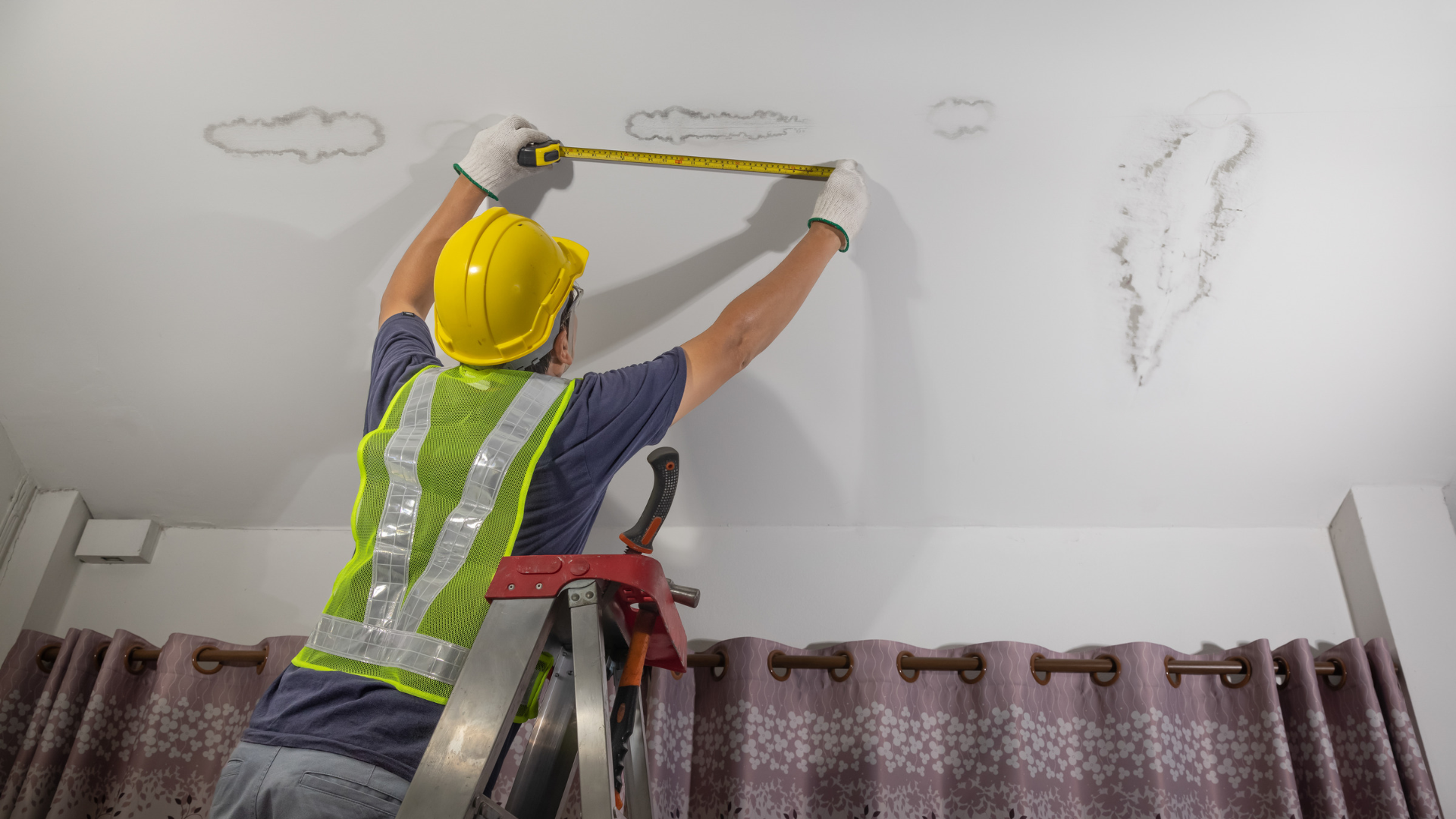
- A ceiling stain that grows during rainfall or snowmelt.
- Damp insulation, dark decking, rusted fasteners, or a musty attic odor.
- Loose shingles or flashing visible near the patched location.
- Repeated interior dripping even though the patch surface looks intact.
| Warning sign | Possible meaning | Recommended response |
|---|---|---|
| Lifted patch edge | Bond has failed or substrate moved | Schedule inspection before snow coverage |
| Cracked roof cement | Patch has lost flexibility | Identify and rebuild the original detail |
| Loose or torn tarp | Exposure may no longer be controlled | Seek prompt professional protection |
| Recurring ceiling stain | Water has bypassed or moved around patch | Trace leak from interior and roof |
| Soft decking near patch | Moisture has affected structural substrate | Expand repair to sound material |
Urgency rises with active water, sagging ceilings, wind damage, or tree impact. Move belongings and stay away from bulging ceilings or wet electrical fixtures. Never add loose plastic, bricks, or boards from a ladder. Roof Repair Pro provides emergency repair in Guilford when temporary protection needs attention.
How a Permanent Repair Differs From Surface Covering
A permanent repair begins by exposing enough of the area to understand why it failed. The roofer removes loose patching as needed, inspects surrounding shingles, flashing, underlayment, membrane, fasteners, and decking, and then rebuilds the affected detail in the correct sequence. Water must be directed over each layer and away from joints rather than relying on a mound of sealant to resist every storm. The completed repair should integrate with sound surrounding material and avoid unnecessary exposed fasteners.
Surface covering can be appropriate for immediate protection, but it often leaves the original failed component in place. Cement over a split pipe boot does not make the rubber new, sealant along loose step flashing does not restore its shingle-like overlap, and a patch over soft decking does not create firm fastening. A proper scope addresses those conditions before closing the roof. That difference is why photos and a written explanation are more useful than a promise that an area was simply “sealed.”
Material Compatibility and Application Conditions Matter
Roofing products have specific surfaces, thicknesses, reinforcement methods, temperatures, and curing conditions. A product suited to asphalt may not work with EPDM, TPO, PVC, silicone, or coatings. The wrong cement can fail to adhere or interfere with later repair.
Check these points before accepting a permanent scope:
- Roof system: Asphalt shingles, modified bitumen, EPDM, TPO, and metal details require different methods.
- Surface condition: Dirt, moisture, frost, loose granules, oxidation, and old cement can interfere with adhesion.
- Temperature: Follow the selected product’s published application range rather than a generic cold-weather claim.
- Joint movement: Flashing and penetration details need materials that tolerate expected expansion and contraction.
- Reinforcement: Some wider cracks or repair areas require compatible fabric or membrane, not cement alone.
- Drainage: The finished work must shed water without creating a pond or blocking an intended outlet.
GAF’s roof-tarping guidance treats tarps as temporary protection that must be installed correctly. Product instructions vary even within one manufacturer’s lineup. Snow or frost should not be sealed beneath permanent work. When conditions are unsuitable, use secure protection and a documented follow-up.
What Proper Repair of an Old Patch Should Include
The permanent repair depends on what the old patch was covering. A shingle defect, flashing joint, pipe boot, and membrane seam cannot all be repaired with the same steps. The scope should state what will be removed, what will be inspected below it, and how the replacement integrates with adjacent roofing.
A complete repair may include:
- Removing loose cement, incompatible sealant, failed tape, or temporary covering.
- Releasing nearby shingles or membrane carefully enough to inspect the original defect.
- Replacing damaged shingles, flashing, boots, collars, fasteners, or membrane sections.
- Repairing localized underlayment and decking where water has caused deterioration.
- Installing replacement components with the required overlaps and fastening pattern.
- Using compatible sealant or cement only where the system detail calls for it.
- Checking uphill transitions so a second leak source is not left above the repair.
- Documenting the completed work and any separate condition that should be monitored.
Our Guilford roof-leak service uses interior clues, exterior inspection, and documentation to locate entry. That matters when old patching hides the original failure. Focused repair remains practical when surrounding roofing is serviceable. Inspection should expand only far enough to reach sound material.
Use a Decision Framework Before Snow Covers the Repair
The presence of an old patch does not automatically mean that the entire roof needs replacement. The decision should follow current performance, substrate condition, repair history, and whether the failed component can be rebuilt. Homeowners can use these questions when comparing recommendations:
- Why was the patch installed? Emergency storm protection and a repeated leak require different follow-up.
- Is the roof currently dry? A dry interior does not prove that the patch is permanent, but active entry raises urgency.
- Can the underlying component be identified? A quote should name the shingle, flashing, boot, seam, or other defect.
- Is the surrounding roof serviceable? Localized work makes sense only when it can tie into sound material.
- Are safe installation conditions available? Temperature, moisture, frost, and access affect scheduling.
- Does the proposal remove unstable patching? Adding another layer may conceal rather than correct the failure.
Published Roof Repair Pro Pricing and Cost Factors
We publish $250–$1,500 for most residential roof repairs in Guilford. Our leak page lists approximately $400–$600 for small repairs, $800–$1,300 for larger repairs, and $300 per hour plus materials outside those tiers. These are planning figures, not an unseen-roof price. Access, pitch, patch removal, material, flashing, and decking determine the quote.
| Published Roof Repair Pro category | Planning figure | Main variables |
|---|---|---|
| Most residential Guilford roof repairs | $250–$1,500 | Repair type, material, pitch, access, damage |
| Small leak repair tier | $400–$600 | Accessible localized shingle, boot, or minor leak work |
| Larger leak repair tier | $800–$1,300 | Broader flashing, membrane, or substrate work |
| Work outside standard tiers | $300 per hour plus materials | Complex diagnosis, access, or unusual scope |
Ask the estimate to separate immediate protection from permanent work. It should identify whether old cement or tarping will be removed, which component will be replaced, whether underlayment or decking is included, and how weather delays will be handled. Two quotes are not equivalent if one covers only another layer of sealant and the other rebuilds flashing or shingles. A clear scope makes the reason for the price understandable before work begins.
Replace the Patch With a Defined Repair Plan
A temporary patch has done its job when it limits damage until safe, compatible permanent work can begin. Before snow conceals the area, confirm what failed, whether the patch remains secure, and whether water has affected material below it. A lasting repair should replace the defective component or rebuild its detail instead of depending on another surface layer. The homeowner should leave the process knowing what was temporary, what was repaired, and what conditions still require monitoring.
If your Guilford roof still depends on a tarp, roof-cement patch, sealant bead, or older emergency repair, Roof Repair Pro can inspect the area and provide a written scope. We serve Guilford, Madison, Branford, North Branford, and Clinton with repair-focused work for shingles, flashing, roof penetrations, membranes, and storm damage. Contact us for a free roof inspection before snow and repeated freezing make the patch harder to evaluate. We will document the defect, explain whether focused repair is practical, and separate immediate protection from the permanent solution.
External references:
- GAF: What to Know About Tarping a Roof
- GAF: MATRIX 204 Wet/Dry Roof Cement Technical Data
- U.S. Department of Energy: Guide to Durable Attics
Related Services